

The arrival at a glance
How to get to Barra Grande
Barra Grande sits at the tip of the Maraú Peninsula, and no paved road reaches it. Every trip ends in one of two ways: a boat crossing over Camamu Bay, or 46 km of dirt road. This guide explains when each one makes sense.
It covers the two airports that serve the area, the crossing from Camamu and the overland route. It does not list schedules or prices: those change by the day and by operator, and have to be confirmed.
The quick answer
Two ways in, and the day decides which
To reach Barra Grande you land in Ilhéus or Salvador, drive on paved road to Camamu and cross the bay by speedboat in about 30 to 40 minutes. The alternative is to skip the crossing: drive all the way to the peninsula and take on the last 46 km on dirt road.
The crossing is faster and more predictable, and it is what most travelers use. The overland route is for people traveling in their own car, arriving outside boat hours or wanting to keep a vehicle at their guesthouse.
What almost always tips the decision is your flight's arrival time. A late-afternoon landing in Salvador rarely makes the last boat of the day in Camamu — and it is that calculation, not the airfare, that usually decides whether the trip fits into a single day.
Geography explains the rest
Where Barra Grande is
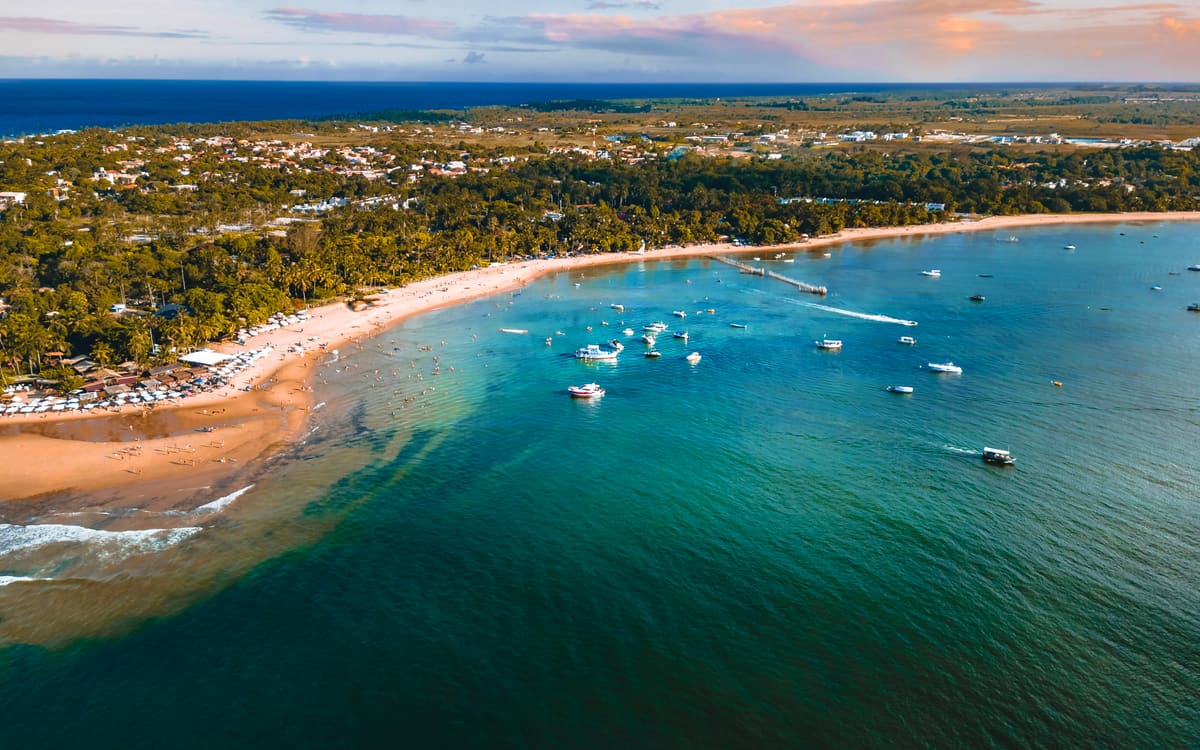
Barra Grande is a village in the municipality of Maraú, on the southern coast of Bahia. It sits on Ponta do Mutá, the northern tip of the Maraú Peninsula — the strip of land that closes off Camamu Bay, one of the largest bays on the Brazilian coast.
That position explains everything that follows. Across the bay, just a few kilometers away as the crow flies, lies the town of Camamu, which has paved road access. Overland, however, the same distance becomes a long loop through the peninsula, almost entirely on unpaved road.
That is why the boat exists as everyday transport rather than a sightseeing trip: it covers in half an hour a journey that takes hours by land.
Stage 1
The airports that serve the area
There is no airport on the Maraú Peninsula. If you arrive by air, you land in Ilhéus or Salvador and finish the trip by road and water.
Ilhéus Airport (IOS)
This is the closest one. It is about 115 km to Camamu, roughly 2 hours on paved road. The airport is small and deplaning is quick, which helps when your timing is tight against the boat schedule.
The trade-off is the choice of flights: there are few daily departures and almost no direct international connections. The guide to arriving via IOS walks through the route stage by stage.
Salvador Airport (SSA)
It is much farther — around 195 km to Camamu when the route uses the ferry from São Joaquim to Bom Despacho, on Itaparica Island. Adding up the ferry, the wait and the drive, the trip to the port usually takes 5 to 6 hours.
In exchange, Salvador has far more flights, more times to choose from and international connections. If you are coming from outside Brazil or from a city with no direct flight to Ilhéus, it is often the only practical way in.
Still deciding on your flight? The side-by-side comparison of the two airports has its own guide.
Compare the airportsStage 2, option A
The crossing from Camamu
Camamu is where you switch. You arrive by car or van on paved road, get off at the port and cross the bay by boat to the Barra Grande pier. By speedboat, the crossing takes 30 to 40 minutes on average.
Departures usually run every hour, roughly from 6 a.m. to 5 p.m. Treat that as a planning reference, not a published timetable: operations vary by the day, by season and with sea conditions.
The town has more than one boarding point, and they are not interchangeable. Arriving without knowing which dock your boat leaves from costs time on exactly the stage with the least slack. The boat crossing guide covers this in detail.
When the crossing is the right call
- You are flying in and not renting a car.
- Your final destination is Barra Grande, Taipu de Fora or a guesthouse at the tip of the peninsula.
- You would rather have a predictable travel time than the freedom of your own car.
- You are traveling with children, and swapping hours of dirt road for 40 minutes on a boat changes the whole day.
Stage 2, option B
The all-road route
Road access to the peninsula is via the BR-030. The final stretch to Barra Grande is about 46 km long and entirely dirt road — there is no paved alternative.
The condition of that stretch is seasonal. In the dry season, after maintenance, a regular car can usually manage it in about 2 hours. During heavy rains, the same stretch may call for four-wheel drive or become impassable.
All told, driving from Ilhéus usually takes 3h30 to 4 hours to Barra Grande. From Salvador, add the 5 to 6 hours to the Camamu area before the final 46 km.
When the road route pays off
- You want a car on the peninsula for your entire stay.
- You arrive outside the hours when the boats operate.
- Your group has luggage or equipment that would make transferring to the boat complicated.
- Recent rain completely changes the travel time and the type of vehicle you need.
- There are no gas stations or repair shops along the dirt stretch.
- Cell service is patchy for much of the way.
Side by side
The routes compared
| Route | Last stage | Reference time | Best for |
|---|---|---|---|
| Ilhéus + boat | ~115 km of paved road to Camamu, then the crossing | ~2h by road + 30 to 40 min by boat | Flying in and wanting the shortest trip |
| Salvador + boat | ~195 km via the Itaparica ferry, then the crossing | 5 to 6h to Camamu + 30 to 40 min by boat | Relying on the capital's wider choice of flights |
| All-road route | 46 km of dirt road via the BR-030 | ~2h on the final stretch, much longer in rain | Traveling in your own car or arriving after boat hours |
Before you ask for a quote
What the team needs to know
A transfer quote for the peninsula doesn't depend on distance alone. It depends on which final stage your arrival allows. These five details are usually enough:
- Your arrival and departure dates.
- Airport and scheduled landing time.
- Number of passengers and amount of luggage.
- Final destination: Barra Grande, Taipu de Fora, Cassange or the name of the guesthouse.
- Whether there are children, surfboards, bulky equipment or stops you need to make.
With that, the team can tell you whether the day allows for the crossing, whether the road route is worth it or whether your arrival should be split over two days — before the ticket is bought.
Individual routes, with specific origins and destinations, are listed on the transfer page.
Common questions
What travelers ask most about this part of the trip
- Which airport should I fly into for Barra Grande?
- Ilhéus (IOS) is the closest — about 115 km to Camamu, roughly 2 hours on paved road. Salvador (SSA) is about 195 km from Camamu via the ferry to Itaparica, and usually adds up to 5 to 6 hours to the port. Ilhéus shortens the trip; Salvador tends to have more flights. The full comparison is in the Salvador or Ilhéus guide.
- Do I have to go through Camamu?
- Not necessarily, but it is the most common way. Camamu is the port where boats leave for Barra Grande, and the crossing takes around 30 to 40 minutes. The alternative is to continue by road to the peninsula, which replaces the crossing with about 46 km of dirt road.
- How long is the boat ride from Camamu to Barra Grande?
- The speedboat crossing over Camamu Bay takes 30 to 40 minutes on average. Larger, slower boats take considerably longer. The boat crossing guide explains how boarding works.
- Is there a fixed time for the last boat?
- Departures usually run every hour, roughly from 6 a.m. to 5 p.m., but that is not a guarantee: times, operators and availability change by the day, by season and with sea conditions. Don't plan a flight around the last departure without confirming first.
- Can I drive to Barra Grande?
- Yes. Road access to the peninsula is via the BR-030, and its final stretch to Barra Grande is about 46 km of dirt road. In dry weather a regular car can manage it; after heavy rain it may call for four-wheel drive or become impassable.
- Can I go straight to Taipu de Fora?
- Yes. Taipu de Fora is on the same peninsula, a few kilometers south of Barra Grande. After the pier or the road there is still a local leg to the beach and the guesthouses, and that leg needs to be arranged together with the rest of the transfer.
- How much does it cost to get to Barra Grande?
- The price depends on where you start, the number of passengers, luggage, the time of day and whether the route uses the boat or the road. That is why quotes are sent on WhatsApp with your trip details, rather than as a fixed price list that wouldn't hold up.
How this guide is maintained
This guide describes the general logistics of arriving in Barra Grande and on the Maraú Peninsula. Distances, times and stages are planning references, not guaranteed schedules: tides, rain, road conditions and same-day availability all change the actual trip. Nothing here replaces confirming your own transfer before you travel.
Updated . If anything on this page is out of date or doesn't match what you found, let the team know through the contact page — the fix goes into the next review.
Get a quote
Confirm your transfer before you book the flight
Send your date, arrival time, number of passengers, luggage and final destination. The team replies with the most practical way to get there on that day.